Image
Congenital heart disease: factors influencing parents’ knowledge of their child’s condition
A literature review to identify factors influencing parents’ knowledge of their child’s CHD
15 Mar 2021
Image
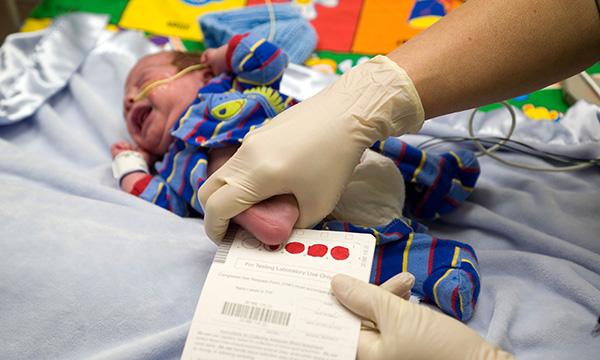
Picture shows a newborn baby undergoing blood spot screening. Research shows that the way parents are told after screening that their child may have cystic fibrosis can affect the depth and duration of their distress.
How parents are told their child may have cystic fibrosis can affect their distress
25 Sep 2019
Image
NBS

Healthcare professionals’ and parents’ experiences of the confirmatory testing period

14 May 2019
Image
Paper examines caregiver burden and quality of life of parents of young children with cystic fibrosis
03 May 2018
Image
Since its roll-out in the UK in 2007, newborn screening programmes to identify cystic fibrosis have proven to help provide growth developments in later life
18 Jan 2017
Image
Sickle-cell disease
Gaining informed consent does not always guarantee that parents are fully aware of the possible outcomes of newborn screening for genetic or congenital conditions
12 Sep 2016

Nurses are well placed to identify behaviour or circumstances that might signify a child is at risk and to contribute to measures designed to protect children. Legislation, guidance and local policies provide the framework for nurses to implement good practice in communication, documentation and multi-agency working to safeguard every child and young person with whom they have contact.

01 May 2005

Nurses are well placed to identify behaviour or circumstances that might signify a child is at risk and to contribute to measures designed to protect children. Legislation, guidance and local policies provide the framework for nurses to implement good practice in communication, documentation and multi-agency working to safeguard every child and young person with whom they have contact.

01 Feb 2005

<p>Shortening waiting times in A&amp;E departments is high on the government agenda. This is highlighted in documents such as The NHS Plan (Department of Health 2000) and Reforming Emergency Care (DoH 2002). Indeed, The NHS Plan states that by this year waiting times in A&amp;E departments should be no more than four hours and an average of 75 minutes. One approach to meeting this target has been to empower appropriately qualified healthcare professionals to undertake a wider range of clinical tasks, such as requesting X-rays (DoH 2000).</p>

01 Feb 2004