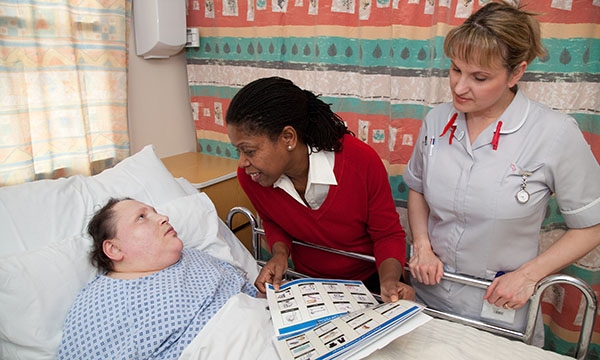
Consultant learning disability nurse Gwen Moulster reviews ebook Nursing in Intellectual Disabilities: Irish and International Perspectives
Independent consultant learning disability nurse, Gwen Moulster reviews Community Care and Inclusion for People with an Intellectual Disability.
Earlier this year, the authors, all members of the UK Learning Disability Consultant Nurse Network, completed development of the Health Equalities Framework. This framework was developed after a review of evidence for health inequalities among service users indicated that outcome measures should be improved across all health and social care services. It explains why the framework should inform the commissioning of services for people with learning disabilities.
<p>In this, the final article in a series of three, Gwen Moulster, Sarah Ames and Tom Griffiths describe the piloting, implementation, auditing and evaluation of the eclectic Moulster and Griffiths framework for learning disability nursing practice. They also highlight some of the issues involved in shifting conventional ideas to a more contemporary methodology of learning disability nursing.</p>
<p>This article, the second in a three-part series, describes a new framework for learning disability practice. It is intended to empower nurses to update their practice, ensure good health outcomes and improve the care experience of people with learning disabilities, and their family, carers and friends. Devised to help nurses work consistently in a structured, evidence-based and reflective way, the framework takes into account their experience and intuitive skills, and the individuality of each person who has learning disabilities. When referring to the framework, learning disability nurses should ensure that healthcare objectives are based on such person-centred aspirations as well as the nurses’ healthcare goals.</p>
<p>This article, the first in a series of three on developing a framework for learning disability nursing practice, discusses how a bespoke nursing model was devised from elements of other models. As the article makes clear, such frameworks must keep up with evolving needs, practices, policies and laws in the learning disability nursing field. The framework, devised by nurses from the Haringey Learning Disabilities Partnership, in London, is reflective, person centred, evidence based and outcome focused.</p>
<p>It has been found in recent years that the healthcare needs of people with learning disabilities have not always been fully met. The authors suggest that this situation can be improved if specialist learning disability nurses are more involved in mainstream services. They argue that learning disability nurses should focus their efforts on health, rather than social care activities, and suggest that there are further groups of people in society who, while not having a learning disability, could benefit from the interventions of this skilled professional group.</p>
<p>Aperson-centred plan (PCP) is not a one-off event but a continuous, evolving process. As Mcintosh (2001) says: ‘Sustained effort will be required from people at all levels…. There is a need to find a set of shared values and build a culture that will change people’s lives, improve all services and have an impact on communities.’</p>
<p>Attempting to involve people with profound and multiple disabilities in staff selection has always presented a challenge. In many services, recruitment decisions have been made with no service user or advocacy involvement, and very little family input. This is particularly true of services that support people with complex communication needs. Because person-centred planning (PCP) can make it easier to identify users’ preferences, it can also provide useful information when recruiting and selecting staff.</p>
<p>Early on in the project, we decided to help a group of people to develop their skills in training others about person-centred planning (PCP). Initially the need for this had arisen from people who had been part of a research project on person-centred planning in the New Forest area. Some service users and family carers had begun to work as speakers, telling their stories about how person-centred planning had worked for them. Some of these people had then wanted to improve their skills in presenting and training, and we soon found that there were plenty of other people in Hampshire who were interested in developing their skills.</p>
<p>The Valuing People White Paper (Department of Health (DH) 2001) is part of the developing social policy driving partnership, empowerment and community responsibility in health and social care. There is an emphasis on enabling individual choice and independence, recognition of people’s rights and the inclusion of all people as valued community participants. At the heart of this is a person-centred approach to help change the way people engage with the world, so they are in control of their own lives.</p>
<p>The Valuing People White Paper (DH 2001) suggests that facilitators are essential to person-centred planning (PCP). In examining the impact of PCP, Robertson et al (2005) found that people were 12 times more likely to have an effective plan if they had a facilitator with a personal commitment to PCP. The literature (for example, Ritchie et al 2003) tends to support the idea that the best way to make plans happen is by training people to act as facilitators.</p>
<p>In January 2004 Hampshire Partnership Board established a person-centred planning team in response to Valuing People (Department of Health (DH) 2001). The board made a unique investment by appointing four co-ordinators and a commissioning officer, initially for 12 months, funded by the Learning Disability Development Fund.</p>