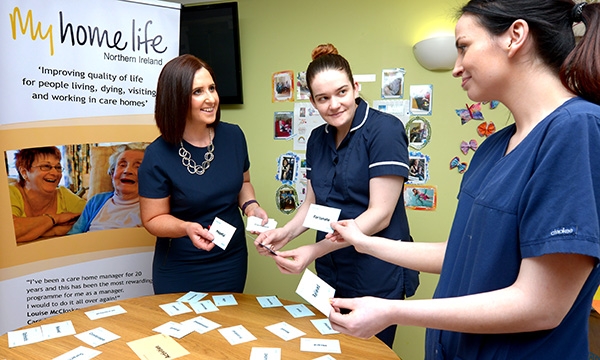
Aim To explore the effect of the My Home Life 12-month leadership support programme on care home managers’ leadership skills and professional development, and their relationships with staff, residents and relatives.
Method A qualitative study of 15 care home managers was undertaken, using focus groups to explore the study’s aims and objectives. Data were analysed using Colaizzi’s phenomenological method.
Findings The leadership support programme enabled managers to develop their leadership skills, which had a positive effect for them and for their relationships with staff, residents and relatives. Conclusion Participation in the programme enabled managers to make real practice development improvements with meaningful effect for residents.
To explore the effect of the My Home Life 12-month leadership support programme on care home managers’ leadership skills and professional development, and their relationships with staff, residents and relatives.
Method
A qualitative study of 15 care home managers was undertaken, using focus groups to explore the study’s aims and objectives. Data were analysed using Colaizzi's phenomenological method.
Findings
The leadership support programme enabled managers to develop their leadership skills, which had a positive effect for them and for their relationships with staff, residents and relatives.
Conclusion
Participation in the programme enabled managers to make real practice development improvements with meaningful effect for residents.
This article presents findings from the first phase of a two-part study that examined the knowledge and experience of emergency department (ED) staff who work with people with mental health needs. In the first part of the study, 19 semi-structured interviews were conducted with multidisciplinary team (MDT) members and the results were analysed. The interviews covered the ED environment, participants’ attitudes towards, ability to communicate with, and knowledge and experience of patients with mental health needs. One of the study’s main findings was that MDT members require more appropriate training to raise their awareness of issues related to mental health. The findings informed the development of a questionnaire, which was distributed to a large cohort of ED staff and social workers.
Aim The aim of this study was to explore how members of a stroke carers’ support group perceived that services for stroke patients and their carers could be improved.
Method A qualitative, experience-based design approach was used to explore the views of ten carers of stroke survivors. Experience questionnaires and a listening lab were used for data collection. Data analysis was carried out using thematic content analysis of the questionnaire and audiotaped transcripts.
Findings Common themes identified included carer loneliness, lack of information, effect of stroke on relationships, carer emotions, loss of privacy and need for ongoing support.
Conclusion There are many advantages to be gained for users and organisations from user involvement in service redesign and delivery.
<p>While the title of this book adequately reflects the content, it falls short of capturing the novel approach the editors have taken to portraying mental health inpatient care. The book is well structured and consists of five discrete sections. The first and final sections are concerned with introductions and conclusions respectively. Section two focuses on service users’ experiences, section three on carers’ experiences and section four on the experiences of mental health staff.</p>