
Image
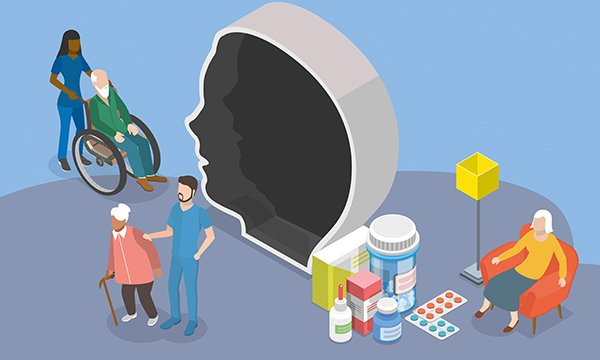
Illustration of antipsychotic medicine in dementia: a new antipsychotic medication toolkit offers advice and guidance, and aids nurses' decision-making when managing distressed behaviour
New toolkit aids decision-making when managing distress in people with dementia
08 Mar 2023
Image
Dementia

The new dementia strategy from the Department of Health's is a positive move, says Rachel Thompson
07 Oct 2016

This is the fourth and final article in a short series that presents case study examples of the positive work achieved by trusts who participated in the Royal College of Nursing’s development programme to improve dementia care in acute hospitals.

Dementia training in hospitals is often inadequate and staff do not always have sufficient knowledge of dementia to provide appropriate care. It can also be difficult for them to identify when patients with dementia are in pain, especially when their communication skills deteriorate. The case studies presented illustrate how two NHS trusts have worked to ensure that their staff are fully equipped to care for people with dementia in hospital.

Basildon and Thurrock University Hospitals NHS Foundation Trust in Essex made dementia training a priority by including dementia awareness in staff induction across a range of roles and providing additional training activities tailored to meet staff needs. Nottingham University Hospitals NHS Trust focused on pain assessment, aiming to standardise its approach for patients with dementia. The pain assessment in advanced dementia tool was chosen and piloted, and is being implemented across the trust after a positive response.

26 Nov 2015

This article is the third in a series presenting examples of the positive work achieved by trusts who participated in the Royal College of Nursing’s development programme to improve dementia care in acute hospitals.

The hospital environment is often disorientating for people with dementia and can be particularly distressing when a patient is admitted in an emergency. Subsequent ward moves can also be disruptive and confusing, especially if they take place out of hours. Two NHS trusts aimed to improve the experience for patients with dementia by addressing the physical environment along with practical aspects of care provision at different stages in the hospital journey. The Queen Elizabeth Hospital King’s Lynn NHS Foundation Trust in Norfolk enhanced its emergency department environment by redesigning four bays and an observation area to be dementia-friendly. The hospital has supported these changes by providing dementia awareness training for all staff in these areas. Walsall Healthcare NHS Trust focused on minimising ward moves by implementing procedures to identify patients who should not be moved. Since introducing the new process, adherence has been good and there have been fewer ward moves.

28 Oct 2015

This is the second in a short series that presents case study examples of the positive work achieved by trusts that participated in the Royal College of Nursing’s development programme to improve dementia care in acute hospitals. Staff often think that there is insufficient time to get to know patients and carers, especially with large and challenging workloads. Combined with a lack of activities and stimulation for patients with dementia in hospital, this can result in poor engagement and a disconnect between staff and patients. To improve these relationships and give staff more time with patients, Cambridge University Hospitals NHS Foundation Trust has introduced bay nursing for patients with dementia, where one nurse is responsible for monitoring a bay alongside a healthcare assistant for an entire shift. Part of Betsi Cadwaladr University Health Board, Glan Clwyd Hospital in north Wales has focused on improving stimulation by creating an activity room with a specially trained activity worker, providing a relaxed and friendly setting where patients with dementia can take part in a range of activities and have lunch together.

24 Sep 2015

This article provides an overview of current developments to support improvements in dementia care in acute general hospital settings. It considers the urgent need for improvement along with the effectiveness of current approaches in achieving change and delivering person-centred care. The process and outcomes of a development programme carried out by the Royal College of Nursing and evaluated by the University of Worcester are described. This programme supported clinical nurse leaders in developing dementia care in nine acute general hospitals by use of an action learning approach. Recommendations are made for a more systematic approach to developing practice that considers the context and culture of acute hospital care for people with dementia. The need for investment in clinical leaders and dementia specialists who can assist improvements and support change is emphasised.

16 Sep 2015

This is the first in a short series that presents case study examples of the positive work achieved by trusts who participated in the Royal College of Nursing’s development programme to improve dementia care in acute hospitals.

When a person with dementia is in hospital, poor understanding of individual needs and preferences can contribute to a lack of person-centred care. Similarly, the needs of family carers can often be overlooked and staff do not always appreciate these needs at such a stressful time. This article illustrates how three NHS trusts have addressed these issues. To help staff get to know patients with dementia, Salford Royal NHS Foundation Trust has implemented a patient passport. Similarly, The Shrewsbury and Telford Hospital NHS Trust has implemented a carer passport that overcomes the restrictions imposed by hospital visiting hours. Royal Devon and Exeter NHS Foundation Trust also focused on carers, holding a workshop to elicit feedback on what was important to them. This was a useful means of engaging with carers and helped staff to realise that even simple changes can have a significant effect.

27 Aug 2015
Image
Dementia improvements

A short series of articles in Nursing Older People, starting in September, presents case study examples of the positive work achieved by trusts that participated in the RCN’s development programme to improve dementia care in acute hospitals. This introductory article reports on the independent evaluation of the programme. The programme included a launch event, development days, site visits, ongoing support by the RCN lead and carer representatives and a conference to showcase service improvements. The evaluation drew on data from a survey, the site visits, trust action plans and a range of self-assessment tools for dementia care. The findings highlight substantial progress towards programme objectives and learning outcomes and suggest that the programme provided the focus, impetus and structure for trusts to make sustainable changes. It also equipped participants with the strategies and confidence to change practice. Recommendations are made for taking the programme forward.

25 Jun 2015

<p>This article describes a practice development project at a gynaecological oncology centre aimed at improving patient experience before admission for major pelvic surgery. Two full-time clinical nurse specialists (CNSs) were involved and the project was supported by a pre-assessment nurse. Centre staff saw 500 patient referrals with a suspected gynaecological malignancy each year. The CNS team thought that, due to the service design, some patients had too little time with a CNS, so a clinic was established to support patients’ care needs; evaluation indicates that the clinic gives patients an opportunity to discuss their pre-operative supportive care needs and enables post-operative care planning. It is now well established and an integral part of the patient pathway.</p>

10 Apr 2012